

Written by Joe Hill for the Greater London Project.
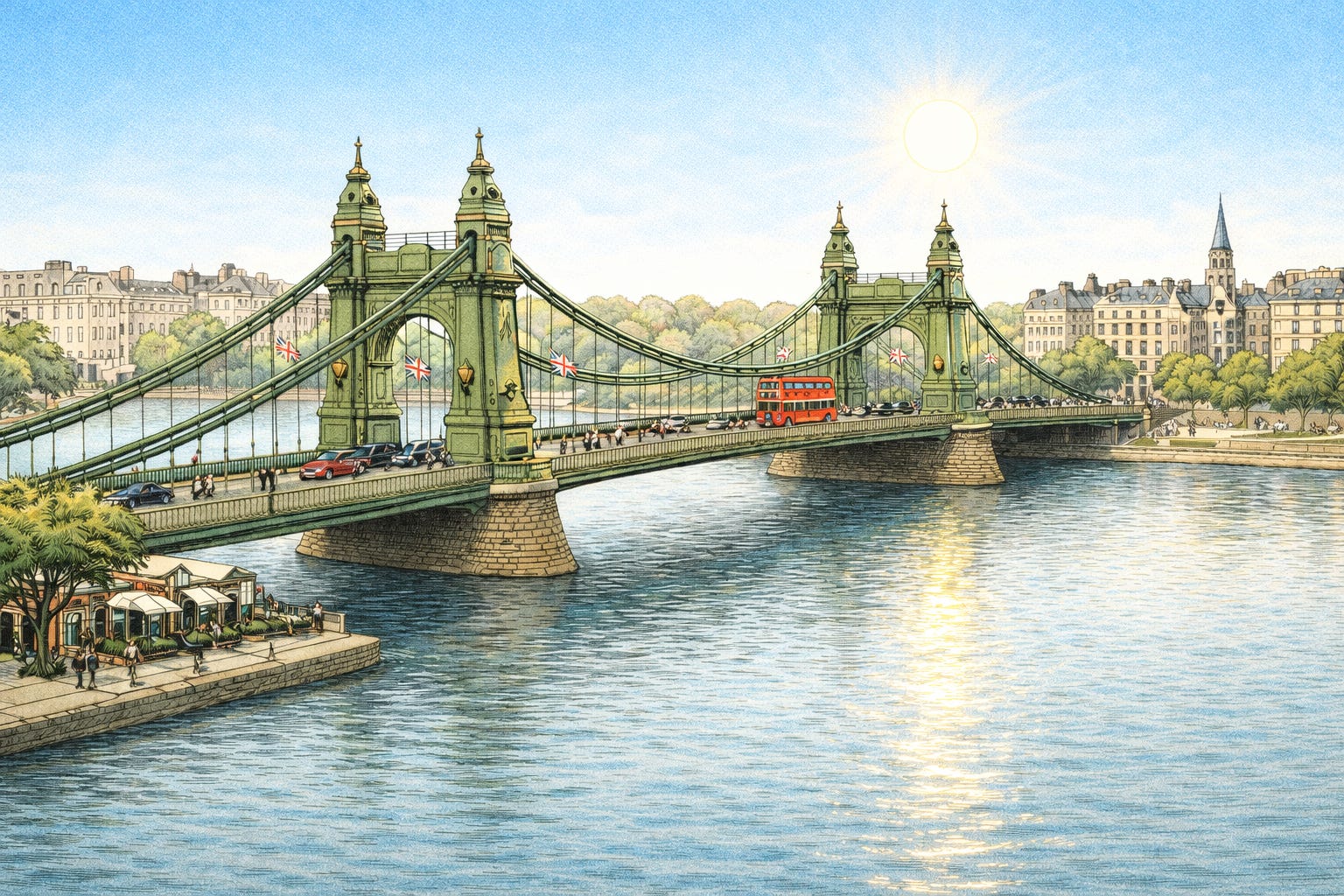
Throughout history, great cities have been made by great rivers: the Nile (Cairo), Tigris (Baghdad), Tiber (Rome), Seine (Paris), Hudson (New York), and the Thames (London). Water was the best means of transportation before roads and cars came along. As waterways go, rivers are a more efficient use of space than coasts; with two banks instead of one shoreline, there’s more space to cluster buildings around the water. But now we’re less reliant on boats, even rivers aren’t as useful. They may even be an overall negative, as they take up valuable space.
But the Thames and London are inseparable – it is part of the city’s landscape and provides a beautiful setting for many neighbourhoods along its banks. We just need the right infrastructure to make it work, and the Thames has many bridges which connect London’s boroughs together.
Bridges are essential to London life. We probably need more, but there’s no point building new ones if we can’t even use the existing ones.
Seven years after Hammersmith Bridge was first closed to traffic it still isn’t open?
The bridge first closed to Londoners in 2019 after engineers assessed that structural damage meant it could collapse. Nick Maini has an excellent long read on the problems with the bridge which explains in more detail how we got here, and what we can do about it.
In short: small fractures in the structure were widening, creating cracks, which risked the bridge’s cast-iron structure shattering suddenly. The safety risks were very real. Stabilisation efforts secured the structure for pedestrians and cyclists, but not normal traffic, and it has cost £48 million to date.
Since then, 9,000 car journeys which happened across the bridge every day have disappeared – they haven’t been replaced. Most of the other journeys shifted to cycling, walking, driving around over Chiswick Bridge or Putney Bridge, or using forms of public transport which don’t rely on the bridge (like buses do). But these 9,000 trips aren’t happening at all. Residents have had to choose to stay put, to not take a new job which would involve a tricky commute, and to ration their travel across West London.
Locals, both residents and businesses, overwhelmingly want the bridge to reopen. So what is happening? For nearly seven years, nothing.
The council asked the Department for Transport to fully restore the bridge in 2023, using a business case based around a Foster & Partners design with a £250 million price tag, and a 10 year construction time. Other designs have been proposed since 2023, but none have caught on since they don’t solve the fundamental problem of cost.
Other ideas have attempted to get around this without starting a big infrastructure project. Licensing rickshaws to cross the bridge, an impractical vehicle toll, and turning the bridge into a monument have all been mooted, but these are all still a retreat, back to a world with fewer options for residents. The scheme’s critics point out how people have adjusted their behaviour, and returning the bridge to operation might be something they want, but not something they need. It’s popular in planning circles to criticise the ‘induced demand’ from new infrastructure, but ultimately it is a good thing. As Ben Southwood has pointed out:
“...If roads exist, people plan their lives around them and use them more. But they do this with every technology. This is just how demand works – it’s not a special type of ‘induced’ demand.
So induced demand is not a helpful concept. We use roads because we want to get around, which we want whether or not roads exist. The upshot is that road infrastructure is good.”
Bridges are no different.
In 2021 the London Borough of Hammersmith and Fulham, Transport for London and the Department for Transport each agreed to fund one third of the restoration. But since then the three parties haven’t been able to get together, agree a plan, and come up with their share of the costs.
Maybe a fourth party could break the deadlock? Last year John Murphy wrote about the history of the City Bridge Foundation (CBF), a charity set up in 1282 to maintain London Bridge, which then began tolling and maintaining other bridges across London. Since 1995, its purpose has changed; now it funds social justice causes. In 2023, it planned to make grants of £30 million, and planned an additional £200 million over the next three years.
CBF has a Board that oversees day to day responsibilities, but the City of London Corporation is the ultimate trustee of the Foundation. Hammersmith might be outside the City’s boundaries, but so too are many of the charitable projects it funds.
Whoever pays, and how, the bridge needs to be fixed. With modern technology, a full rebuild to match the original architecture (but with stronger materials) might be preferable to a workaround which preserves the Grade II listing (which was only granted in 2008). The legacy of the bridge’s Victorian builders shouldn’t be that we maintain it at all cost – they would no doubt be horrified at the cost and time overruns involved in replacing their creation. The spirit of their age should inspire us to build like they did.
Londoners have been building bridges across the Thames since the Romans did in the first century AD, all the way up to the Millennium Bridge in 2000. Forget building another one: if we can’t repair Hammersmith Bridge, not only will West London be divided in two for traffic and public transport, but will be a symbol that we’ve given up on building the most basic infrastructure a city needs.
The campaign group Looking for Growth (LFG) is calling for the Transport Secretary Heidi Alexander to break the institutional stalemate and rebuild the bridge; first with a temporary road bridge, then a permanent one. You can and should sign their open letter here.
Community notes:
What we’ve been reading
Urban expansion in the age of liberalism by Samuel Hughes
Inventing fun by Alys Key
Support Shoreditch Works!
If the government is serious about growth it should approve Shoreditch Works by Nicholas Boys Smith
Please support the campaign to get Shoreditch Works built. You can write to them at planning [at] hackney [dot] gov [dot] uk quoting ‘Shoreditch Works application 2024/2201’ in the subject line with your comments.
Or, turn out in person to support the proposal. Hackney’s planning sub-committee meeting is at 18:30 on Wednesday, 4th February, at the Council Chamber, Hackney Town Hall. You can just turn up.
The details of the planning application are here.
Thank you for linking to my piece Joe.
Bridges are good, and more bridges are better. But not every bridge needs cars.
We have the opportunity to rebuild Hammersmith bridge for the future - for public transport, bikes and pedestrian users - for the city we’re becoming: denser, greener, and designed for people.
That’s why a public transport oriented solution like autonomous vehicles should be on the table - not only does it solve the real underlying problem, but it’s also way quicker and cheaper and gives people the options they want and deserve.
The existing historic structure is fine for foot, bycycle and light stuff. Its use should be promoted.It was never intended for 50 tonne trucks.